
Your position:HOME > PRODUCTS > Acoustic Emission Sensors > Sensor Model List >
Acoustic Emission Sensor Model List
Model:
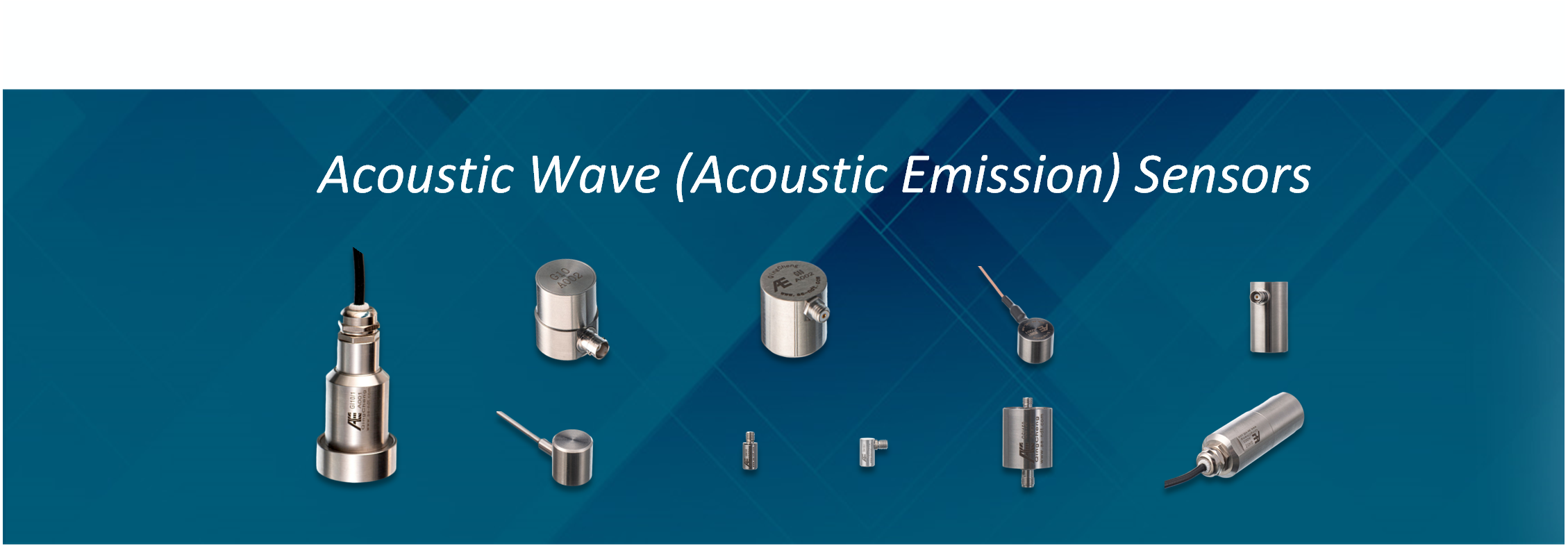
All acoustic wave(Acoustic Emission)sensor models
Description:
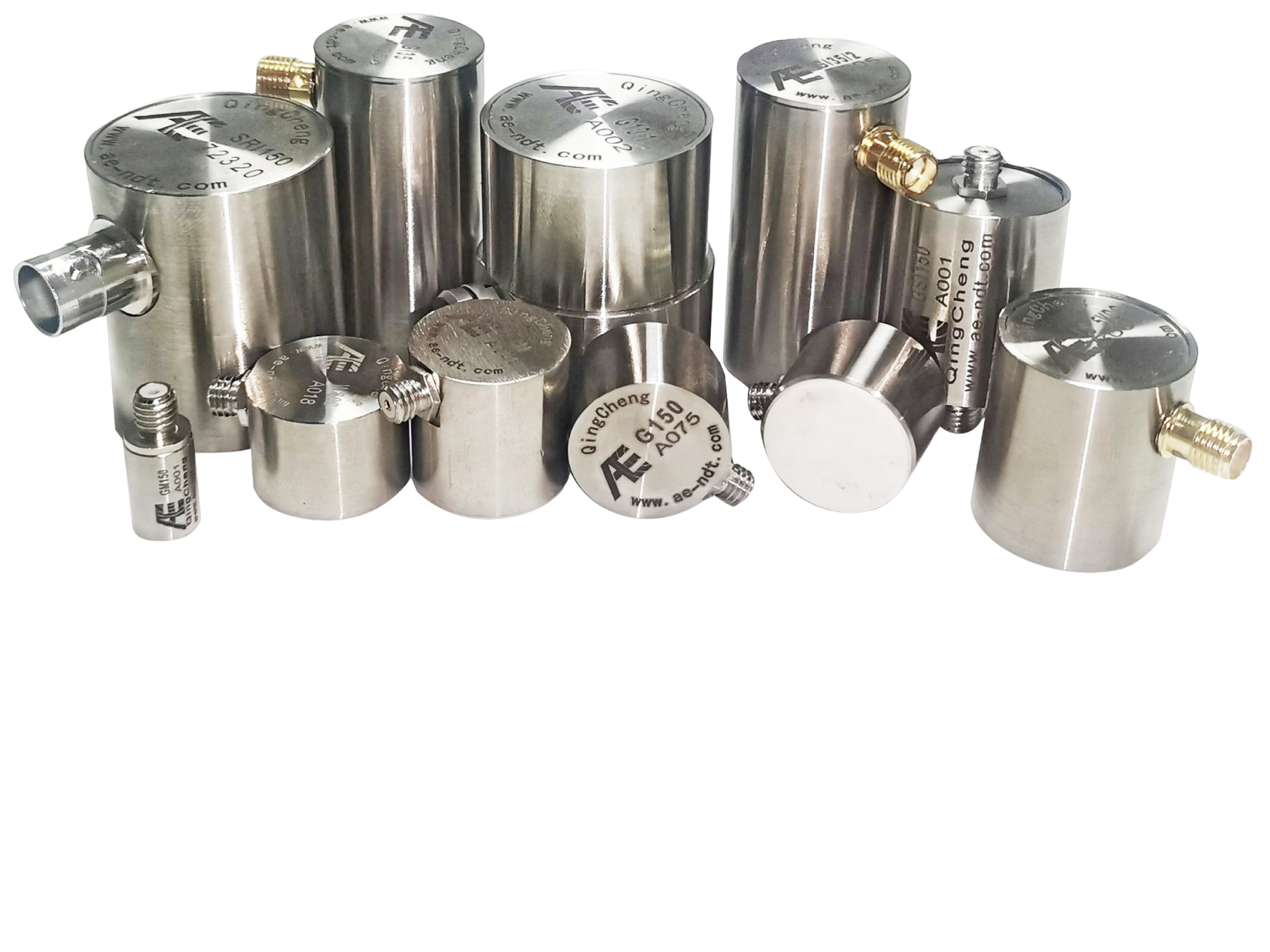
Compare AE sensor models by resonant frequency, frequency range, sensitivity, preamplifier type, size, temperature rating, connector and application. Select AE sensors for crack detection, leakage monitoring, corrosion diagnosis, partial discharge, composite testing and structural health monitoring.
Features:
Multiple frequency options / Passive and integral preamplifier designs / Compatible with our AE systems and most standard acoustic emission acquisition instruments / Customized sensor design available

Acoustic Emission Sensor Model List and Selection Table
Compare AE sensors by frequency, sensitivity, temperature, preamplifier type and application
QAWRUMS provides a complete acoustic emission sensor model list to help engineers compare and select AE sensors for different testing and monitoring applications. This selection table includes general-purpose AE sensors, integral preamplifier sensors, broadband sensors, high-temperature sensors, miniature sensors, differential sensors, intrinsically safe sensors, and customized acoustic emission sensors.
You can compare each model by resonant frequency, frequency range, sensitivity, preamplifier type, size, weight, operating temperature, protection grade, connector type, mounting method, cable model, and typical applications. These AE sensors are used for crack detection, leakage monitoring, corrosion diagnosis, partial discharge detection, composite material testing, pressure vessels, pipelines, tanks, valves, bridges, rotating equipment, and long-term structural health monitoring.
AE Sensor Selection Guide
For most metallic structures such as pressure vessels, storage tanks, pipelines, and steel components, resonant AE sensors around 150 kHz are commonly used because they provide high sensitivity and good signal-to-noise (SNR) ratio for crack growth and active damage detection.
For low-frequency applications such as leakage detection, corrosion activity, partial discharge, rock testing, or buried pipeline monitoring, 10 kHz, 40 kHz, or 80 kHz AE sensors may be more suitable depending on signal attenuation and background noise.
For waveform analysis, frequency spectrum research, composite materials, or applications where the source frequency is unknown, broadband AE sensors are recommended because they provide a wider frequency response.
For harsh environments, choose high-temperature, intrinsically safe, waterproof, differential, or miniature AE sensors according to the installation conditions, operating temperature, cable length, noise level, and safety requirements.
If you are not sure which model to choose, please contact us with your material, structure type, expected AE source, temperature, installation method, and acquisition system. Our technical team can recommend suitable AE sensors for your application.
AE Sensor Model Comparison Table
The table below lists standard Qawrums acoustic emission sensor models and their main technical specs. Click each model name to view detailed specifications, frequency response, dimensions, installation information, and recommended applications.
Standard Acoustic Emission Sensor Models
| Sensor Model | Resonant Freq.(kHz) | Freq. Range(kHz) | Sensitivity Peak(dB) | Integral Preamp. | Size DxH (mm) | Weight (g) | Working Temp. (℃) | Case Material | Face Material | Protect Grade | Connector Type | Connector Location | Hold-down Model | Cables Model | Field of Applications |
| Commonly Used Acoustic Emission Sensors | |||||||||||||||
| G150 | 150 | 60~400 | ﹥69 | / | Φ19×15 | 23 | -20~120 | Stainless steel/copper/aluminum | Ceramic | IP62 | M5 | Side | M20 | RG178/RG316 | Crack or fault diagnosis of metal |
| GI150 | 150 | 60~400 | ﹥69 | 40dB28V | Φ30×36.5 | 120 | -20~50 | Stainless steel/copper/aluminum | Ceramic | IP62 | BNC | Side | M36 | SYV-50-3/ STYV-50-2 | Crack of metal, partial discharge, fiber |
| G40 | 40 | 15~70 | ﹥69 | / | Φ22×36.8 | 82 | -20~120 | Stainless steel/copper/aluminum | Ceramic | IP62 | M5 | Side | Saddle type | RG178/RG316 | Rock or partial discharge, leakage, corrosion |
| GI40 | 40 | 15~70 | ﹥75 | 40dB28V | Φ30×57 | 193 | -20~50 | Stainless steel/copper/aluminum | Ceramic | IP62 | BNC | Side | M36A | SYV-50-3/ STYV-50-2 | Partial discharge, leakage, corrosion |
| General Purpose Acoustic Emission Sensors | |||||||||||||||
| G150 | 150 | 60~400 | ﹥69 | / | Φ19×15 | 23 | -20~120 | Stainless steel/copper/aluminum | Ceramic | IP62 | M5 | Side | M20 | RG178/RG316 | Crack or fault diagnosis of metal |
| G150/1 | 150 | 60~400 | ﹥69 | / | Φ19×15 | 50 | -20~120 | Stainless steel/copper/aluminum | Ceramic | IP68 | BNC on integral cable | Side | M20 | SYV-50-3/ STYV-50-2 | Crack or fault diagnosis of metal |
| G150/2 | 150 | 60~400 | >64 | / | Φ19×19.5 | 55 | -20~120 | Stainless steel/copper/aluminum | Stainless steel | IP68 | BNC on integral cable | Side | M20A | SYV-50-3/ STYV-50-2 | Crack or fault diagnosis of metal |
| G80 | 80 | 20~180 | ﹥69 | / | Φ19×19.5 | 33 | -20~120 | Stainless steel/copper/aluminum | Ceramic | IP62 | M5 | Side | M20A | RG178/RG316 | Rock or partial discharge |
| G80/1 | 80 | 20~180 | ﹥69 | / | Φ19×19.5 | 59 | -20~120 | Stainless steel/copper/aluminum | Ceramic | IP68 | BNC on integral cable | Side | M20A | SYV-50-3/ STYV-50-2 | Rock or partial discharge |
| G40 | 40 | 15~70 | ﹥69 | / | Φ22×36.8 | 82 | -20~120 | Stainless steel/copper/aluminum | Ceramic | IP62 | M5 | Side | Saddle type | RG178/RG316 | Rock or partial discharge, leakage, corrosion |
| G10 | / | 1~15 | >80 | / | Φ31×38 | 213 | -20~120 | SUS-304 | Ceramic | IP62 | BNC | Side | M36 | SYV-50-3/ STYV-50-2 | Leakage、slope detecting |
| G10/1 | / | 1~15 | >80 | / | Φ31×38 | 214 | -20~120 | SUS-304 | Ceramic | IP62 | Single-core lemo | Side | M36 | RG178 | Leakage、slope detecting |
| Integral Preamplifier Acoustic Emission Sensors | |||||||||||||||
| GI150 | 150 | 60~400 | ﹥69 | 40dB28V | Φ30×36.5 | 120 | -20~50 | Stainless steel/copper/aluminum | Ceramic | IP62 | BNC | Side | M36 | SYV-50-3/ STYV-50-2 | Crack of metal, partial discharge, fiber |
| GI150/1 | 150 | 60~400 | ﹥69 | 40dB28V | Φ22×25.5 | 38 | -20~50 | Stainless steel/copper/aluminum | Ceramic | IP62 | SMA | Side | Saddle type | RG178/RG316 | Crack or fault diagnosis of metal |
| GI150/2 | 150 | 60~400 | >69 | 26dB5V | Φ22×25.5 | 38 | -20~50 | Stainless steel/copper/aluminum | Ceramic | IP62 | SMA | Side | Saddle type | RG178/RG316 | Crack or fault diagnosis of metal |
| GI150/3 | 150 | 60~400 | >69 | 34dB12V | Φ22×25.5 | 38 | -20~50 | Stainless steel/copper/aluminum | Ceramic | IP62 | SMA | Side | Saddle type | RG178/RG316 | Crack or fault diagnosis of metal |
| GI150/4 | 150 | 60~400 | ﹥69 | 40dB28V | Φ30×35 | 115 | -20~50 | Stainless steel/copper/aluminum | Ceramic | IP62 | M5 | Side | M36 | RG178/RG316 | Crack or fault diagnosis of metal |
| GI150/5 | 150 | 60~400 | ﹥69 | 26dB5V | Φ22×30 | 48 | -20~50 | Stainless steel/copper/aluminum | Stainless Invar Steel/copper | IP62 | SMA | Top | Saddle type | RG178/RG316 | Crack of metal, partial discharge, fiber |
| GI80 | 80 | 20~180 | ﹥69 | 40dB28V | Φ22×25.5 | 43 | -20~50 | Stainless steel/copper/aluminum | Ceramic | IP62 | SMA | Side | Saddle type | SYV-50-3/ STYV-50-2 | Partial discharge, leakage, corrosion |
| GI40 | 40 | 15~70 | ﹥75 | 40dB28V | Φ30×57 | 193 | -20~50 | Stainless steel/copper/aluminum | Ceramic | IP62 | BNC | Side | M36A | SYV-50-3/ STYV-50-2 | Partial discharge, leakage, corrosion |
| GI40/2 | 40 | 15~70 | ﹥75 | 40dB28V | Φ41×92 | 1280 | -20~50 | Stainless steel/copper/aluminum | Stainless steel | IP68 | BNC on integral cable | Top | / | SYV-50-3/ STYV-50-2 | Partial discharge, leakage, corrosion |
| GI35 | 40 | 15~70 | ﹥75 | 40dB28V | Φ22×42.6 | 79 | -20~50 | Stainless steel/copper/aluminum | Ceramic | IP62 | SMA | Side | Saddle type | RG178/RG316 | Partial discharge, leakage, corrosion |
| GI35/1 | 40 | 15~70 | >75 | 26dB5V | Φ22×42.6 | 79 | -20~50 | Stainless steel/copper/aluminum | Ceramic | IP62 | SMA | Side | Saddle type | RG178/RG316 | Partial discharge, leakage, corrosion |
| GI35/2 | 40 | 15~70 | >75 | 34dB12V | Φ22×42.6 | 79 | -20~50 | Stainless steel/copper/aluminum | Ceramic | IP62 | SMA | Side | Saddle type | RG178/RG316 | Partial discharge, leakage, corrosion |
| GI10 | / | 1~15 | ﹥80 | 26dB5V | Φ38.5×85 | 720 | -20~50 | SUS-304 | Stainless steel | IP68 | BNC on integral cable | Top | Self-magnetic | SYV-50-3/ STYV-50-2 | Buried pipeline leakage detection, slope geology |
| GI10/1 | / | 1~15 | ﹥80 | 34dB12V | Φ38.5×85 | 720 | -20~50 | SUS-304 | Stainless steel | IP68 | BNC on integral cable | Top | Self-magnetic | SYV-50-3/ STYV-50-2 | Buried pipeline leakage detection, slope geology |
| WI800 | 600 | 50~800 | ﹥58 | 40dB28V | Φ22×25.5 | 32.29 | -20~50 | Stainless steel/copper/aluminum | Ceramic | IP62 | SMA | Side | Saddle type | RG178/RG316 | Spectrum research |
| WI800/1 | 600 | 50~800 | ﹥58 | 26dB5V | Φ22×25.5 | 33.63 | -20~50 | Stainless steel/copper/aluminum | Ceramic | IP62 | SMA | Side | Saddle type | RG178/RG316 | Spectrum research |
| High Temperature Acoustic Emission Sensors | |||||||||||||||
| GH150 | 150 | 60~400 | >40 | / | Φ19×19.5 | 125 | -20~600 | Stainless Invar Steel/copper | Stainless Invar Steel/copper | IP62 | BNC on integral cable | Side | H20 | SYV-50-3/ STYV-50-2 | HT environment |
| GH150/1 | 150 | 60~400 | >55 | / | Φ19×19.5 | 105 | -20~350 | Stainless Invar Steel/copper | Stainless Invar Steel/copper | IP62 | BNC on integral cable | Side | H20 | SYV-50-3/ STYV-50-2 | HT environment |
| GH150/2 | 150 | 60~400 | >68 | / | Φ19×15 | 45 | -20~170 | Stainless steel/copper/aluminum | Ceramic | IP65 | BNC on integral cable | Side | H20 | SYV-50-3/ STYV-50-2 | HT environment |
| W500/3 | 260 | 40-600 | >55 | / | Φ7.8x14 | 24 | -60~177 | Stainless steel/copper/aluminum | Ceramic | IP65 | BNC on integral cable | Side | Saddle type | RG178-PFA | pressure vessels, storage tanks |
| Intrinsically Safe Acoustic Emission Sensors | |||||||||||||||
| GSI150 | 150 | 60~400 | >69 | 26dB5V | Φ19×14 | 26 |
Sensor:-20 to 170℃ Preamp:-20 to 60℃ |
Stainless steel/copper/aluminum | Ceramic | IP68 | SMA on integral cable | Top | / | RG178/RG316 | Crack or fault diagnosis of metal |
| GI150/5 | 150 | 60~400 | ﹥69 | 26dB5V | Φ22×30 | 48 | -20~50 | Stainless steel/copper/aluminum | Stainless steel/copper | IP62 | SMA | Top | Saddle type | RG178/RG316 | Crack of metal, partial discharge, fiber |
| GIS35 | 40 | 15~70 | >75 | 26dB5V | Φ22×42.6 | 76 | -20~50 | Stainless steel/copper/aluminum | Ceramic | IP62 | SMA | Side | Saddle type | RG178/RG316 | Leakage, corrosion |
| Differential Acoustic Emission Sensors | |||||||||||||||
| GD150 | 150 | 60~400 | ﹥65 | / | Φ19×19.5 | 67 | -20~120 | Stainless steel/copper/aluminum | Ceramic | IP68 | Double-core BNC on integral cable | Side | M20A | / | Crack detection under high noise |
| GD40 | 35 | 15~70 | >65 | / | Φ22×25 | 106 | -20~120 | Stainless steel/copper/aluminum | Ceramic | IP68 | Double-core BNC on integral cable | Side | Saddle type | / | Partial discharge, leakage, corrosion |
| Miniature Acoustic Emission Sensors | |||||||||||||||
| GM150 | 150 | 70~280 | >59 | / | Φ7.8×19 | 5 | -20~120 | Stainless steel/copper/aluminum | Ceramic | IP62 | M5 | Top | Saddle type | RG178/RG316 | Crack or fault diagnosis of metal for narrow space |
| GM150/1 | 150 | 70~280 | >59 | / | Φ7.8×14 | 5 | -20~120 | Stainless steel/copper/aluminum | Ceramic | IP62 | M5 | Side | Saddle type | RG178/RG316 | Crack or fault diagnosis of metal for narrow space |
| WM500/1 | 500 | 100~1000 | >58 | / | Φ4.7×4.0 | 13 | -20~120 | Stainless steel/copper/aluminum | Stainless steel/copper/aluminum | IP65 | BNC on integral cable | Side | Saddle type | SYV-50-3/ STYV-50-2 | Spectrum research, composite materials |
| W500/3 | 260 | 40-600 | >55 | / | Φ7.8x14 | 24 | -60~177 | Stainless steel/copper/aluminum | Ceramic | IP65 | BNC on integral cable | Side | Saddle type | RG178-PFA | pressure vessels, storage tanks |
| Wideband Acoustic Emission Sensors | |||||||||||||||
| W800 | 600 | 50~800 | >58 | / | Φ19×15 | 18 | -20~120 | Stainless steel/copper/aluminum | Ceramic | IP62 | M5 | Side | M20 | RG178/RG316 | Spectrum research, composite materials |
| W800/1 | 600 | 50~800 | >58 | / | Φ19×15 | 45 | -20~120 | Stainless steel/copper/aluminum | Ceramic | IP68 | BNC on integral cable | Side | M20 | SYV-50-3/ STYV-50-2 | Spectrum research, composite materials |
| WI800 | 600 | 50~800 | ﹥58 | 40dB28V | Φ22×25.5 | 32.29 | -20~50 | Stainless steel/copper/aluminum | Ceramic | IP62 | SMA | Side | Saddle type | RG178/RG316 | Spectrum research |
| WI800/1 | 600 | 50~800 | ﹥58 | 26dB5V | Φ22×25.5 | 33.63 | -20~50 | Stainless steel/copper/aluminum | Ceramic | IP62 | SMA | Side | Saddle type | RG178/RG316 | Spectrum research |
| WM500/1 | 500 | 100~1000 | >58 | / | Φ4.7×4.0 | 13 | -20~120 | Stainless steel/copper/aluminum | Stainless steel/copper/aluminum | IP68 | BNC on integral cable | Side | Saddle type | SYV-50-3/ STYV-50-2 | Spectrum research, composite materials |
| W500/3 | 260 | 40-600 | >55 | / | Φ7.8x14 | 24 | -60~177 | Stainless steel/copper/aluminum | Ceramic | IP65 | BNC on integral cable | Side | Saddle type | RG178-PFA | pressure vessels, storage tanks |
Notes for Waterproof and Customized AE Sensors:
1. For SMA connector models, the protection grade can be upgraded depending on the cable and sealing design. Waterproof cable assembly is required for waterproof applications.
2. Standard waterproof AE sensors are generally designed for fresh water at room temperature. For seawater, salt lake water, corrosive liquids, or long-term underwater use at elevated temperatures, please contact us for a customized sealing and material solution.
3. Sensor sensitivity, frequency response, cable length, connector type, mounting accessories, and temperature resistance can be customized according to application requirements.
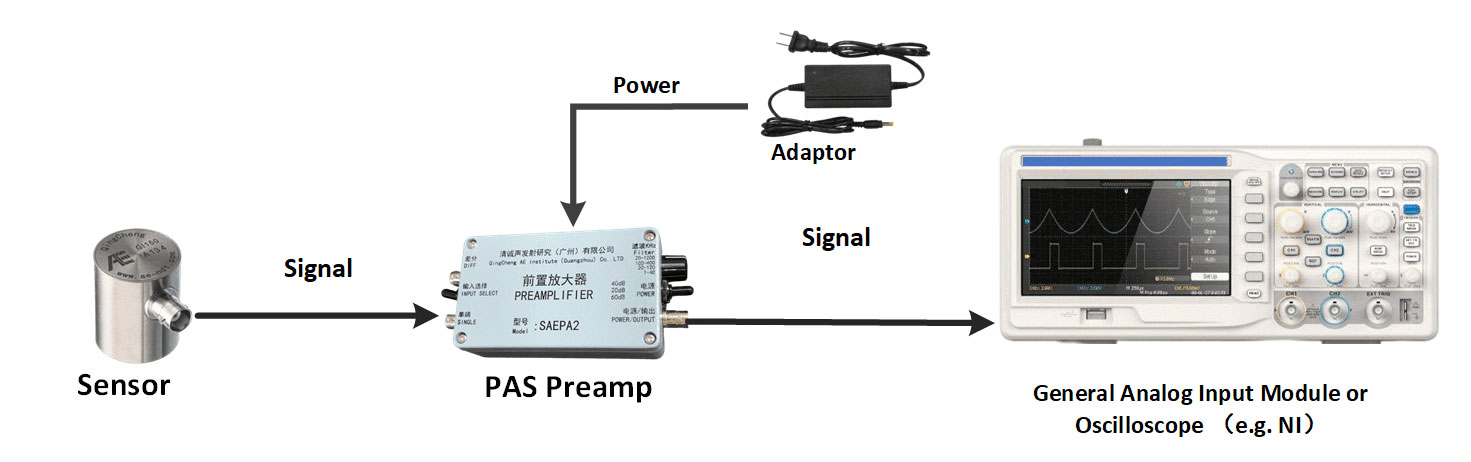
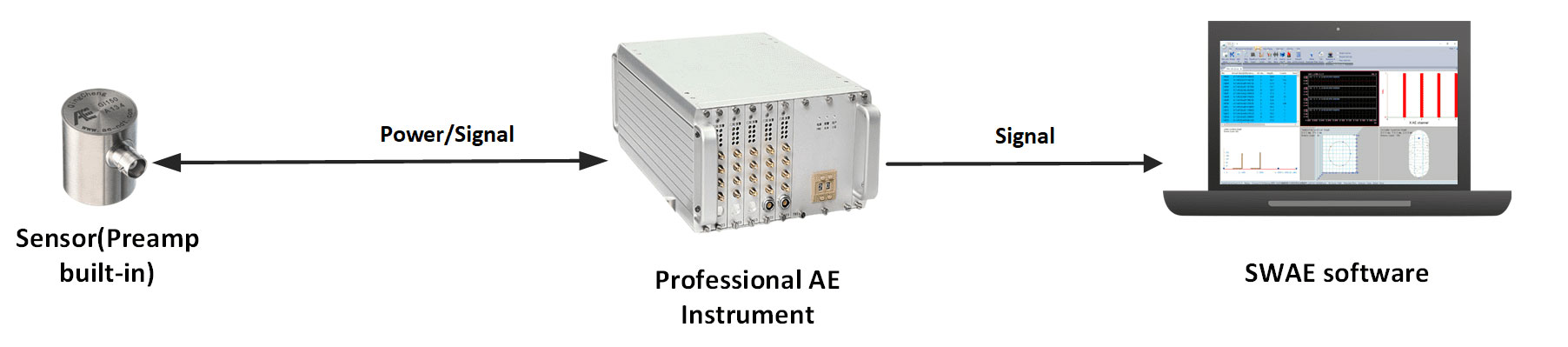
AE Sensor Connection Diagram
1) General AE Sensor + Preamp + Standard AE Acquisition System + Analysis Software

2) General AE Sensor + Preamp (with External Power Adaptor) + General DAQ / Oscilloscope
3) Integral Preamp AE Sensor + Standard AE Acquisition System + Analysis Software
FAQ:
1) How do I choose an acoustic emission sensor?
Choose an AE sensor based on material type, expected AE source (cracks, friction, leaks, corrosion etc.), frequency range, sensitivity, operating temperature, installation space, background noise, and acquisition system compatibility.
2) What is the most commonly used AE sensor frequency?
For many metallic structures, 150 kHz resonant AE sensors are commonly used because they provide high sensitivity and good signal-to-noise ratio for crack detection and structural monitoring.
3) When should I use a broadband AE sensor?
Broadband AE sensors are recommended for waveform analysis, frequency spectrum research, composite materials, and applications where the AE source frequency is unknown.
4) When should I use an integral preamplifier AE sensor?
Integral preamplifier AE sensors are useful when installation space, cable length, field noise, or simplified wiring are important considerations.
5) Can AE sensors be customized?
Yes. AE sensors can be customized for frequency response, sensitivity, temperature resistance, size, connector type, cable length, waterproofing, and special installation requirements.
6) Are AE sensors compatible with different acquisition systems?
Most AE sensors can be used with standard acoustic emission acquisition systems (Qawrums (Qingcheng / Soundwel) / Mistras (Physical Acoustics) / Vallen ) if the connector, preamplifier, power supply, impedance, and signal input requirements are compatible.
Further Information
 Acoustic Emission Sensor Calibration Standard Transfer Flow Chart.pdf
Need Help Choosing an AE Sensor?
Selecting the right acoustic emission sensor depends on material type, AE source, frequency range, sensitivity, temperature, installation space, coupling method, background noise, and acquisition system. If you are not sure which model is suitable, send us your application details and our technical team will recommend AE sensor options.
contact us for AE sensor selection support, customized sensor design, or system compatibility consultation.