

Acoustic Emission Knowledge
Active vs Passive Monitoring
Brief:Active and passive monitoring represent two complementary approaches to evaluating structural integrity. Active methods rely on externally generated signals to detect existing defects, while passive methods—such as acoustic emission—detect naturally oc
Active vs Passive Monitoring
Definition
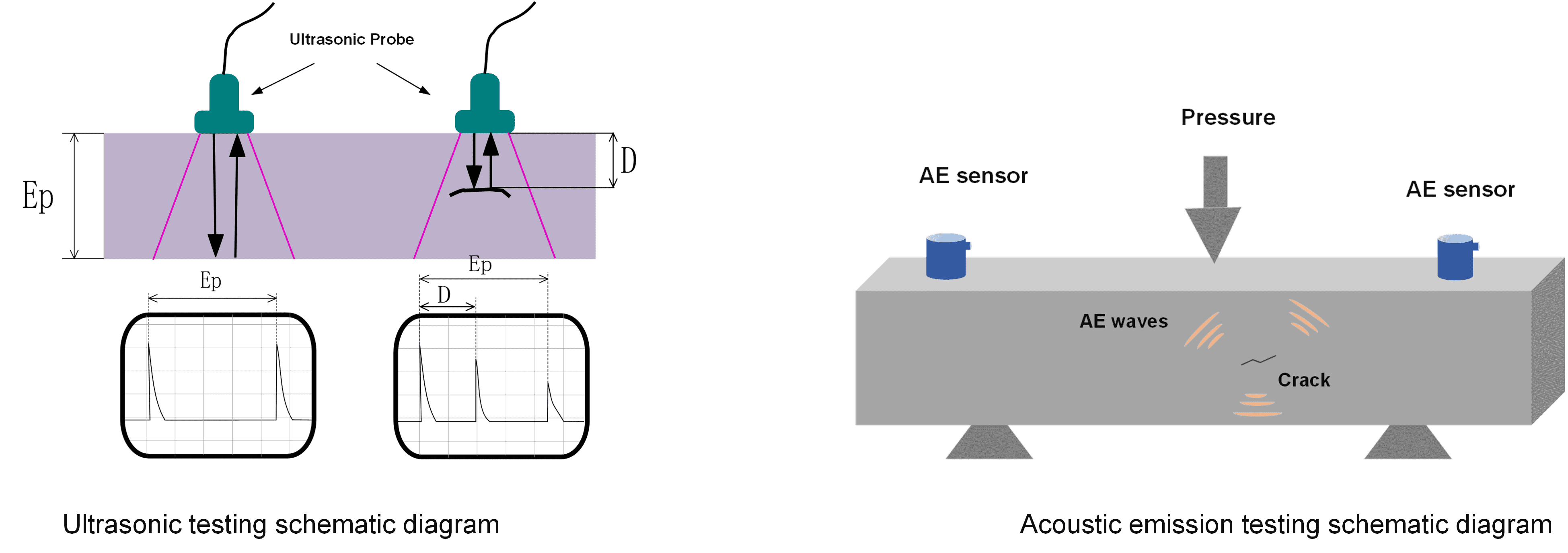
Active monitoring and passive monitoring are two fundamental approaches used in nondestructive testing and structural health monitoring to evaluate the condition of materials and structures.
- Active monitoring involves introducing an external signal or energy into a system and analyzing its response.
- Passive monitoring involves detecting signals that are naturally generated by the structure itself during operation or loading.
Acoustic emission monitoring is a passive technique, while methods such as ultrasonic testing are typically
Key Difference at a Glance
| Aspect | Active Monitoring | Passive Monitoring |
| Signal source | External excitation | Internal structural activity |
| Energy input | Required | Not required |
| Detection focus | Structural condition | Structural activity |
| Typical operation | Periodic inspection | Continuous monitoring |
| Example methods | Ultrasonic testing | Acoustic emission |
How Active Monitoring Works
Active monitoring systems operate by injecting energy into a structure and observing how that energy propagates or reflects.
Typical Process
- 1.A signal (e.g., ultrasonic wave) is generated
- 2.The signal travels through the material
- 3.Reflections or changes are detected
- 4.The response is analyzed to identify defects
What It Detects
- Existing defects (cracks, voids, inclusions)
- Material thickness or geometry changes
- Structural discontinuities
Key Characteristics
- Controlled and repeatable
- High resolution for defect sizing
- Usually requires access to inspection areas
How Passive Monitoring Works
Passive monitoring relies on detecting naturally occurring signals generated by the structure.
Typical Process
- 1.Structural activity occurs (e.g., crack growth)
- 2.Energy is released as elastic waves
- 3.Sensors detect these waves
- 4.Signals are analyzed to identify active processes
What It Detects
- Damage initiation
- Crack propagation
- Deformation processes
- Leakage or friction
Key Characteristics
- No external excitation required
- Captures real-time structural behavior
- Sensitive to active damage only
Acoustic Emission as a Passive Technique
Acoustic emission is a representative example of passive monitoring.
Unlike active methods, AE:
- Detects when damage occurs, not just where it exists
- Operates under real loading or service conditions
- Enables continuous and remote monitoring
This makes AE particularly suitable for:
- large-scale structures,
- critical infrastructure,
- and systems where shutdown is not feasible
Detection Philosophy: Condition vs Activity
The most important conceptual difference is:
Active monitoring detects structural condition, while passive monitoring detects structural activity.
Active Monitoring
- “Is there a defect?”
- Provides a snapshot of the structure
Passive Monitoring
- “Is the structure changing or degrading?”
- Provides time-dependent insight
Both perspectives are valuable but serve different purposes.
Advantages and Limitations
Active Monitoring
Advantages
- High accuracy in defect characterization
- Repeatable measurements
- Well-established standards
Limitations
- Requires system access and downtime
- Limited to inspection intervals
- May miss early-stage damage
Passive Monitoring
Advantages
- Real-time detection of active damage
- Suitable for continuous monitoring
- Covers large areas with fewer sensors
Limitations
- Sensitive to noise
- Requires signal interpretation expertise
- Does not detect inactive defects
When to Use Active vs Passive Monitoring
Active Monitoring Is Suitable When:
- Precise defect sizing is required
- Scheduled inspections are feasible
- Access to the structure is available
Passive Monitoring Is Suitable When:
- Early warning of damage is critical
- Continuous monitoring is needed
- Structures operate under load
- Large areas must be covered
Hybrid Monitoring Strategies
In many engineering applications, the most effective approach is to combine both methods.
Typical Strategy
- Use passive monitoring (AE) for early detection and alerting
- Use active methods (e.g., ultrasonic testing) for detailed inspection and validation
This combination provides both:
- timely detection, and
- accurate characterization
Practical Example
Pressure Vessel Monitoring
-
Passive (AE)
Detects active crack growth during pressurization -
Active (Ultrasonic Testing)
Measures crack size during scheduled inspections
Together, they provide a comprehensive understanding of structural integrity.
Frequently Asked Questions
-
1.Is passive monitoring less accurate than active monitoring?
Not necessarily. Passive monitoring is highly sensitive to active damage but may not provide precise sizing like active methods.
-
2.Can active monitoring detect early damage?
It can detect small defects, but only if inspections are performed at the right time. Passive monitoring can capture damage as it occurs.
-
3.Is acoustic emission always passive?
Yes. Acoustic emission relies on naturally generated signals and does not introduce external excitation.
Related Topics
- What is Acoustic Emission
- AE Physical Mechanisms
- Types of AE Sources
- Acoustic Emission vs Other NDT Methods
Summary
Active and passive monitoring represent two complementary approaches to evaluating structural integrity. Active methods rely on externally generated signals to detect existing defects, while passive methods—such as acoustic emission—detect naturally occurring signals associated with active damage processes. Understanding the differences between these approaches enables engineers to select appropriate monitoring strategies and, in many cases, combine them for more effective structural assessment.