
Acoustic Emission Monitoring for Pressure Vessels and Storage Tanks
Acoustic Emission Solutions for Pressure Equipment and Storage Assets
QAWRUMS provides acoustic emission (AE) testing and monitoring solutions for pressure vessels, boilers, reactors, towers, heat exchangers and aboveground storage tanks.
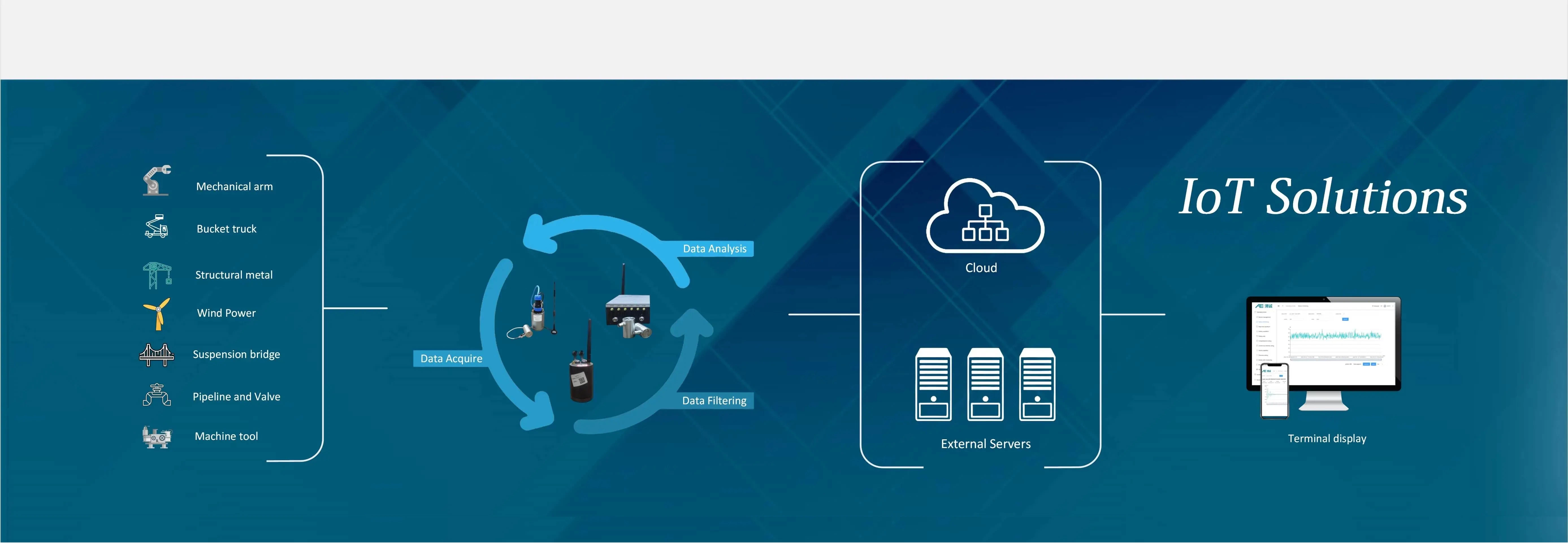
Acoustic emission technology helps detect active damage sources by listening to elastic waves generated from cracks, leakage, weld activity, corrosion-related damage or other abnormal structural activity. AE sensors installed on the equipment surface receive these signals and transmit them to the acquisition system for real-time analysis, source location and alarm evaluation.
Whether you need pressure vessel inspection during a hydrostatic test or storage tank bottom corrosion monitoring without opening the tank, QAWRUMS can provide suitable AE sensors, preamplifiers, acquisition systems, software and monitoring solutions.
Choose the Right AE Monitoring Solution
Pressure vessels and storage tanks are both important industrial assets, but their acoustic emission monitoring purposes are different.
For pressure vessels, AE testing is mainly used to detect active cracks, leakage, weld activity, fatigue damage and abnormal acoustic sources under pressure or loading conditions.
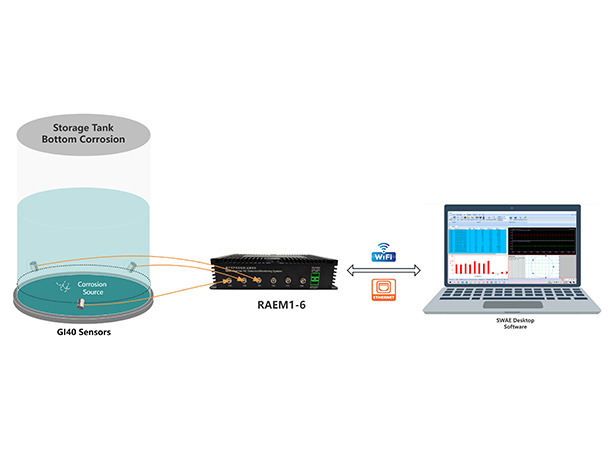
For aboveground storage tanks, AE monitoring is mainly used to evaluate tank bottom plate corrosion, leakage and active corrosion sources, especially when the tank cannot be opened, cleaned or taken out of service.
Solution 1: Pressure Vessel AE Testing and Monitoring
For Pressure Vessels, Boilers, Reactors and Pressure Equipment
Pressure vessels are commonly exposed to internal pressure, temperature variation, corrosion, fatigue, vibration and cyclic loading. Active defects may occur in welds, nozzles, heads, shells or other high-stress areas.
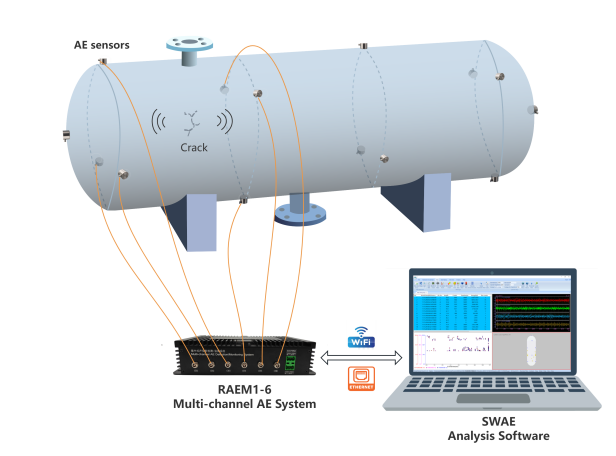
Acoustic emission testing can monitor the whole pressure vessel during pressure loading or operation. When an active crack grows, leakage occurs, or a defect releases stress energy, elastic waves are generated and transmitted through the vessel wall. AE sensors detect these signals and help locate the active source area.
Typical Applications
- Pressure vessels
- Boilers and steam drums
- Reactors and separators
- Absorption towers and columns
- Heat exchangers
- Coke drums and high-temperature vessels
- Gas cylinders
- Pressure pipelines
- Other pressure-retaining equipment
Typical AE Detection Targets
- Active crack growth
- Weld activity
- Leakage
- Fatigue damage
- Stress corrosion cracking
- Local structural damage
- Abnormal stress release
- Corrosion-related cracking or leakage
Main Advantages
- Global monitoring of the pressure vessel during one loading process
- Real-time detection during hydrostatic or pneumatic pressure testing
- Source location capability with multiple AE sensors
- Reduced inspection blindness compared with purely local inspection
- Useful guidance for follow-up UT, PAUT, MT, PT or visual inspection
- Suitable for both short-term testing and long-term online monitoring
Recommended System
A pressure vessel AE testing system usually includes AE sensors, preamplifiers, low-noise signal cables, multi-channel AE acquisition system, pressure input, analysis software and source location function.
The system can record AE parameters such as amplitude, energy, counts, duration, rise time, ASL, RMS, waveform and pressure history. With proper sensor layout and calibration, the software can provide AE source location maps and activity trends.
Solution 2: Aboveground Storage Tank Bottom Corrosion Monitoring
For Atmospheric Storage Tanks and AST Bottom Plate Evaluation
Aboveground storage tanks may suffer from bottom plate corrosion, leakage and corrosion-related damage after long-term service. Traditional internal inspection usually requires emptying, cleaning and opening the tank, which can be costly and time-consuming.
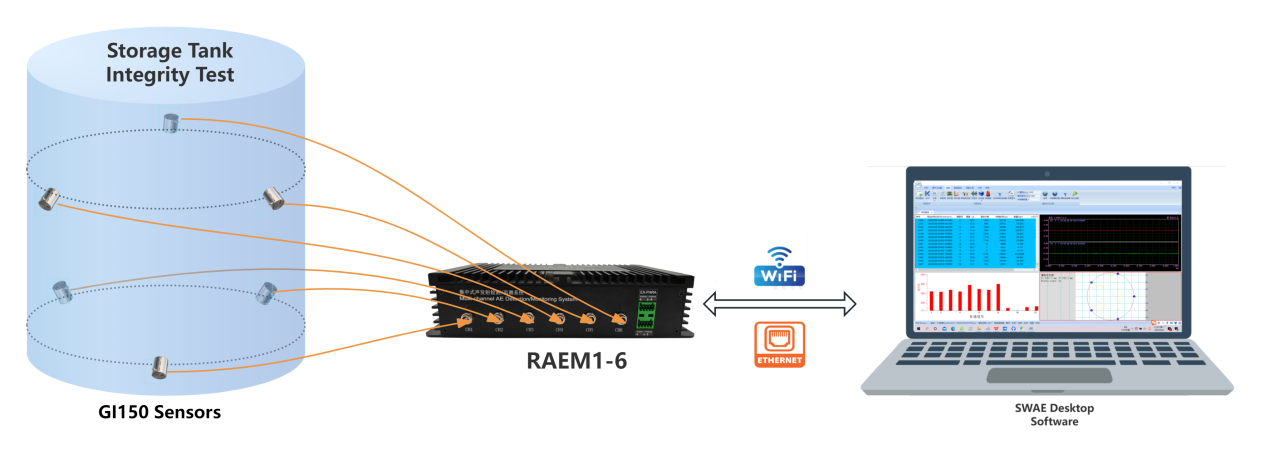
Acoustic emission testing provides a non-intrusive method to evaluate active corrosion and leakage-related acoustic sources from the tank bottom. AE sensors are typically installed around the lower shell of the tank. The system collects signals generated by active corrosion, leakage or other acoustic sources and helps evaluate the tank bottom condition.
Typical Applications
- Aboveground storage tanks
- Atmospheric storage tanks
- Oil storage tanks
- Chemical storage tanks
- Water storage tanks
- Large flat-bottom tanks
- Tank bottom corrosion screening
- Tank leakage monitoring
Typical AE Detection Targets
- Active tank bottom corrosion
- Leakage-related acoustic sources
- Corrosion activity distribution
- Abnormal acoustic activity from tank bottom area
- Long-term tank condition trend
Main Advantages
- No need to open the tank for preliminary screening
- No need to empty or clean the tank for AE monitoring
- Suitable for large storage tanks
- Helps evaluate active corrosion risk
- Supports maintenance planning and inspection prioritization
- Suitable for periodic testing or online monitoring
Recommended System
A storage tank AE monitoring solution usually includes AE sensors installed around the tank lower shell, preamplifiers, signal cables, AE acquisition system and analysis software.
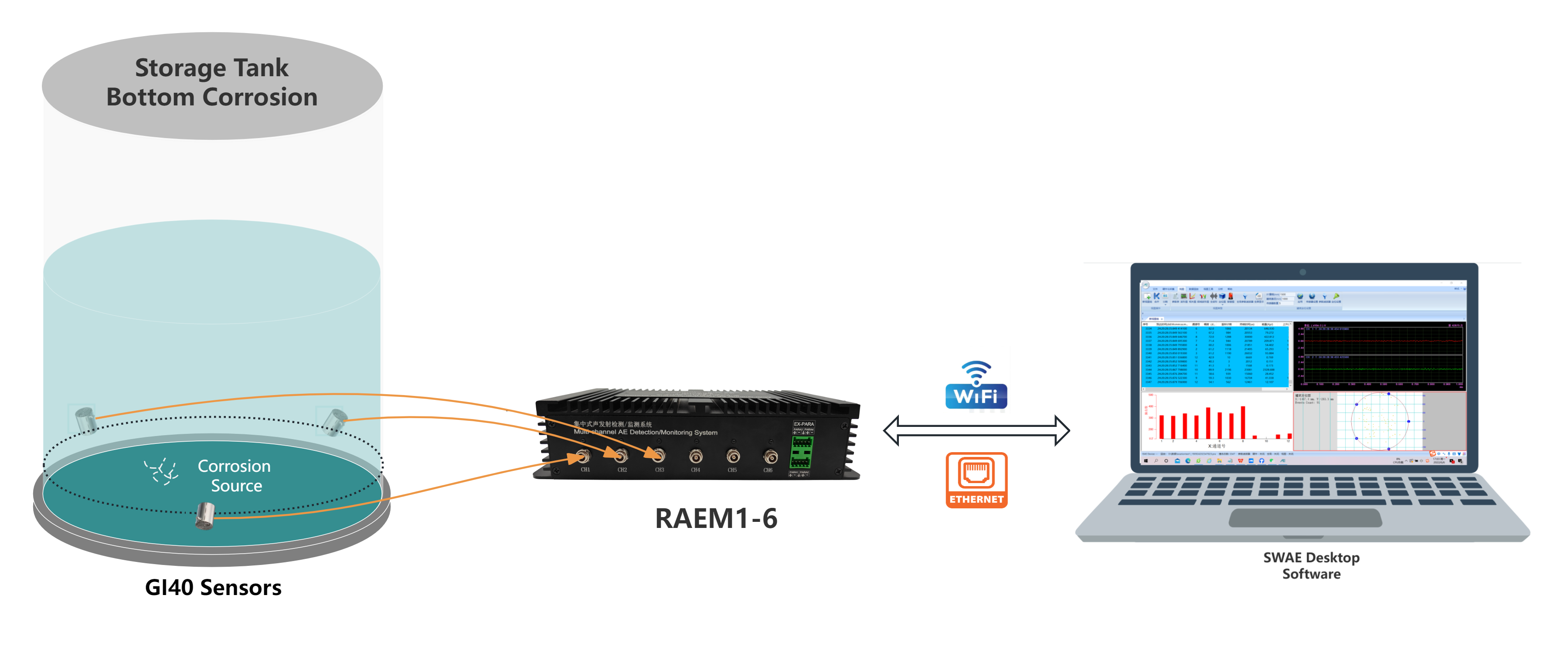
For online monitoring, remote data access, alarm output, trend analysis and cloud-based monitoring can be configured according to the project requirements.
Pressure Vessel vs Storage Tank AE Monitoring
| Item | Pressure Vessel AE Testing | Storage Tank AE Monitoring |
| Main object | Pressure vessels, boilers, reactors, towers, heat exchangers | Aboveground storage tanks and atmospheric tanks |
| Main purpose | Detect active cracks, leakage, weld activity and fatigue damage | Evaluate tank bottom corrosion, leakage and active corrosion sources |
| Loading condition | Internal pressure, pressure test, thermal stress or operating load | Static storage condition, corrosion activity or leakage process |
| Typical sensor position | The whole vessel shell, especially welds, nozzles, shell, heads and high-stress areas | Lower shell around the tank bottom |
| Common system | Multi-channel AE testing system or online AE monitoring system | AST corrosion detection system or tank online monitoring system |
| Output result | Source location, AE activity trend, pressure-related signal analysis | Corrosion activity evaluation, leakage indication, tank bottom activity trend |
| Follow-up inspection | UT, PAUT, MT, PT or local inspection of active source areas | Tank bottom inspection, corrosion verification or maintenance planning |
How Acoustic Emission Monitoring Works
The basic AE monitoring process is similar for both pressure vessels and storage tanks.
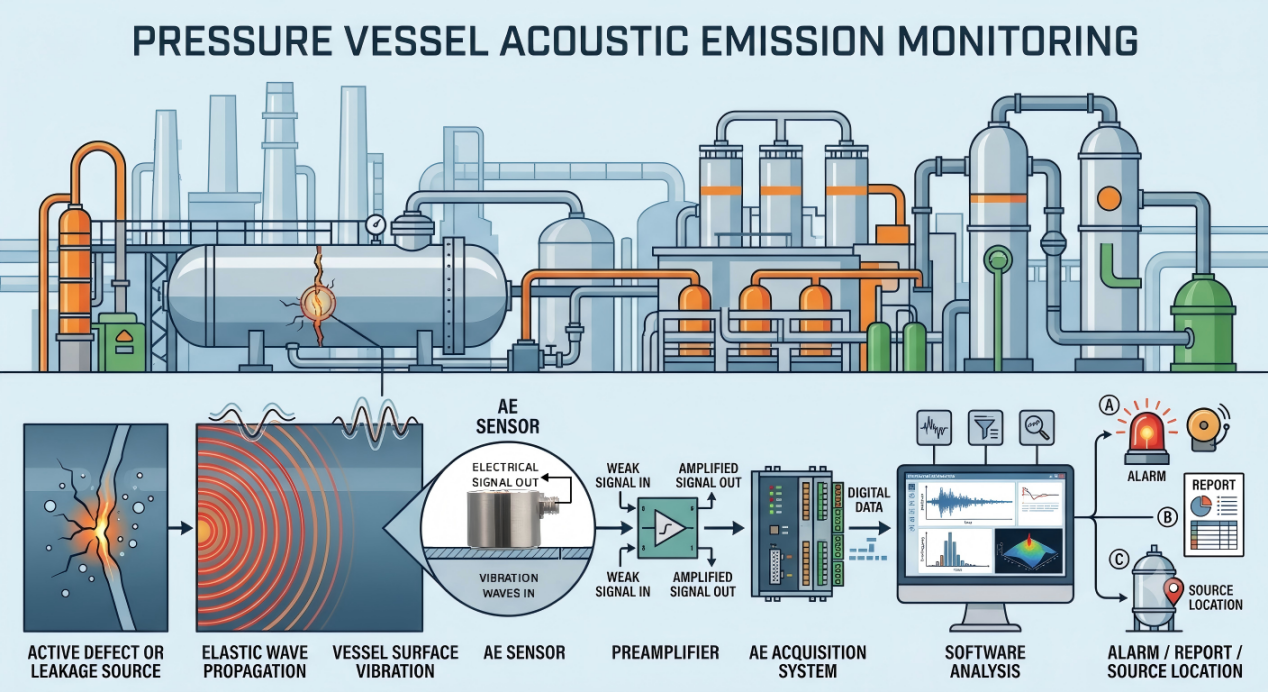
AE technology is especially useful for detecting active sources. A completely inactive defect may not generate detectable AE signals. Therefore, the testing condition, loading process, background noise and sensor layout are important for reliable AE evaluation.
Recommended Products
QAWRUMS can provide complete acoustic emission testing and monitoring configurations for different industrial applications.
AE Acquisition Systems
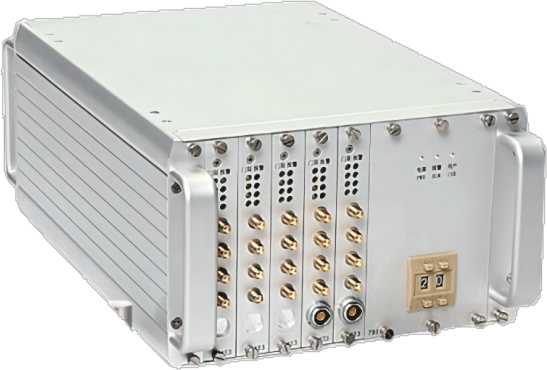
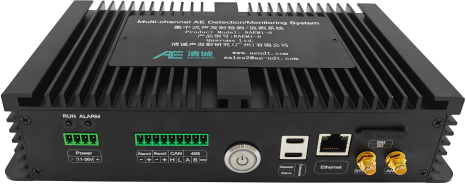
Multi-channel AE acquisition systems can be used for pressure vessel testing, tank bottom corrosion detection, source location and long-term monitoring. For critical assets, online AE monitoring systems can provide continuous signal acquisition, remote access, alarm output and long-term trend analysis.
| SAEU3H Multi-Channel AE System | RAEM1-6 Multi-Channel Monitoring System |
 |
 |
Recommended for pressure testing, proof testing and projects requiring high-performance synchronized multi-channel acquisition and source location.
|
RAEM1-6 can be used when the application requires distributed acquisition, standalone operation or remote data transmission.
|
AE Sensors
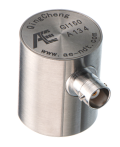
Different AE sensors can be selected according to tank/vessel material, frequency range, sensitivity, surface temperature, installation environment and expected signal characteristics.
| GI150 Sensor | GI40 Sensor |
 |
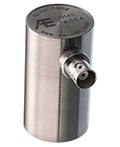 |
| GI150 sensor is recommended for metal pressure vessel testing. | GI40 sensor is recommended for storage tank bottom corrosion monitoring. |
The above sensors are integral sensors that include preamplifier inside. Contact us to help you select or evaluate the suitable sensors for your own project.
Preamplifiers and Cables
Preamplifiers amplify weak AE signals from sensors, while low-noise cables ensure reliable signal transmission in industrial environments. The preamplifier can be built-in the sensor (integral sensors like GI150 or GI40 above) or be external independent component after the general sensor.
Typical Project Workflow
Both schedule testing projects and long-term monitoring projects workflow is like below.
1. Application Review
We review the equipment type, size, material, operating pressure, temperature, medium, inspection purpose and expected damage mechanism.
2. Solution Design
Based on the equipment condition and monitoring target, we recommend the AE system, sensor type, channel number, sensor layout and data analysis method.
3. System Installation
AE sensors are installed on suitable positions with proper coupling and fixation. Preamplifiers, cables, acquisition units and pressure or process inputs are connected according to the testing plan.
4. System Verification
Before formal testing, channel sensitivity, background noise, coupling quality and source location performance are checked.
5. Data Acquisition
The AE system collects signals during pressure loading, operation or long-term monitoring. Data can be analyzed in real time and stored for further evaluation.
6. Analysis and Report
The software provides AE parameter analysis, trend curves, source location maps, alarm records and recommended follow-up inspection areas.
Note: Step 3-6 are handled by the customers. We can provide online and remote supports.
FAQ
Q1: Is this page for pressure vessels or storage tanks?
This page is an overview of QAWRUMS acoustic emission solutions for both pressure vessels and storage tanks. If your application is a pressure vessel, boiler, reactor or tower, please visit the Pressure Vessel AE Testing System page. If your application is an aboveground storage tank or AST bottom corrosion monitoring, please visit the Storage Tank Corrosion Monitoring page.
Q1: What is the main difference between pressure vessel AE testing and tank AE monitoring?
Pressure vessel AE testing focuses on active cracks, weld activity, leakage and fatigue damage under pressure or loading conditions. Storage tank AE monitoring focuses mainly on bottom plate corrosion, leakage and active corrosion sources in atmospheric storage tanks.
Q3: Can AE testing locate defects?
Yes. With multiple AE sensors and proper calibration, the system can estimate the source location of acoustic emission activity. The result helps identify suspicious areas for follow-up inspection.
Q4: Can AE detect inactive defects?
AE testing is mainly sensitive to active defects. A completely inactive defect may not generate detectable acoustic emission signals. Therefore, AE is best used when the equipment is under pressure, load, thermal stress, corrosion activity or operating conditions.
Q5: Does AE replace ultrasonic testing or other NDT methods?
Usually no. AE is a global monitoring and screening method. It helps identify active source areas. Follow-up methods such as ultrasonic testing, phased array UT, magnetic particle testing, penetrant testing or visual inspection may be used to confirm and size the defect.
Q6: Can AE be used for online monitoring?
Yes. AE systems can be configured for short-term testing, periodic inspection or long-term online monitoring. Online monitoring can provide continuous data acquisition, alarm output, trend analysis and remote access.
Get the Right AE Monitoring Solution
Not sure whether your application belongs to pressure vessel testing or storage tank corrosion monitoring?
Contact us and share your equipment information. Our team will recommend a suitable AE testing or monitoring configuration based on your equipment type, material, pressure, temperature, inspection target and site conditions.
Please provide:
- Equipment type
- Size and geometry
- Material and wall thickness
- Operating pressure or storage condition
- Temperature and medium
- Inspection purpose
- Expected damage type
- Testing or monitoring duration
- Site environment
- Required output or report format
Contact Form
Please complete the form below to request your quote. We will be in contact as soon as possible.